Lunch and Learn - Good Governance and Regulation in the Management of Volunteers
Lunch and Learn - Good Governance and Regulation in the Management of Volunteers
Lunch and Learn - Good Governance and Regulation in the Management of Volunteers

Volunteero
Volunteero
13 Oct 2026
13 Oct 2026

Share
Share
Following the success of our Lunch & Learn on Volunteering and the Law, we’re excited to be hosting a follow-up session looking at volunteering through a trustee and governance lens.
Good Governance and Regulation in the Management of Volunteers: Duties, Risks, and Practical Guidance for Trustees
Many trustees are unclear about their responsibilities regarding volunteers. It is often assumed to be operational, but trustees have a strategic role to consider and must be mindful of the regulatory context in which volunteers operate as well as general law and practice, for which they assume responsibility. This session would cover:
Trustees’ responsibilities
Where Trustees' responsibilities sit with volunteers, the duty of care, what's board-level versus what's operational, and the questions they should be asking.
Risk management
Volunteer-related risks that should be on the risk register, insurance gaps Trustees need to spot, safeguarding as a governance issue, and the financial risks around expenses, trading, and liability.
When things go wrong
How volunteer issues can trigger Charity Commission involvement (whistleblowing), real examples from statutory inquiries (if possible), what counts as a serious incident, what the Charity Commission expects of Trustees in the context of the management of volunteers, and how to avoid becoming a case study.
Practical guidance
The policies you should have in place for your volunteers, red flags that mean you've got a governance gap, how to get effective reporting on volunteer matters, and due diligence questions worth asking.
Kirsty’s bio
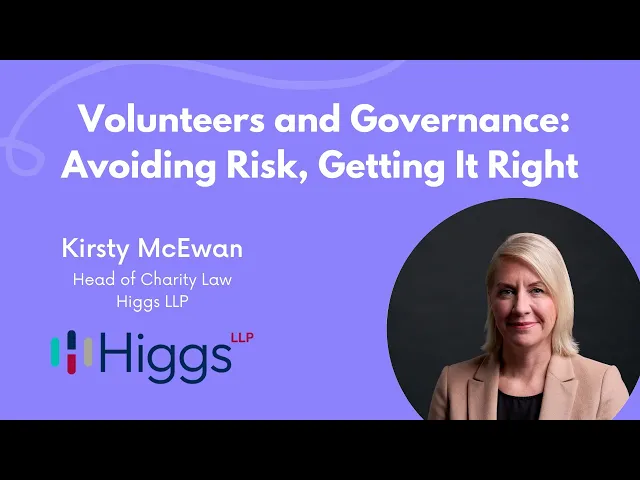
Kirsty leads the charity and not-for-profit team at Higgs LLP. She has been advising charities on constitutional, governance and regulatory matters for over 20 years. She works with organisations across the third sector, from small start-ups to established regional and national charities, with particular expertise in restructuring, complex constitutional issues, governance disputes, and Charity Commission regulatory engagement. Kirsty sits on the Charity Commission's panel as an approved Interim Manager and has developed a reputation for supporting trustees through statutory inquiries and regulatory challenges. She practices what she preaches, serving as a trustee herself and actively fundraising for charity, including running the London Marathon. She also shares practical guidance on charity law through her LinkedIn newsletter.
Following the success of our Lunch & Learn on Volunteering and the Law, we’re excited to be hosting a follow-up session looking at volunteering through a trustee and governance lens.
Good Governance and Regulation in the Management of Volunteers: Duties, Risks, and Practical Guidance for Trustees
Many trustees are unclear about their responsibilities regarding volunteers. It is often assumed to be operational, but trustees have a strategic role to consider and must be mindful of the regulatory context in which volunteers operate as well as general law and practice, for which they assume responsibility. This session would cover:
Trustees’ responsibilities
Where Trustees' responsibilities sit with volunteers, the duty of care, what's board-level versus what's operational, and the questions they should be asking.
Risk management
Volunteer-related risks that should be on the risk register, insurance gaps Trustees need to spot, safeguarding as a governance issue, and the financial risks around expenses, trading, and liability.
When things go wrong
How volunteer issues can trigger Charity Commission involvement (whistleblowing), real examples from statutory inquiries (if possible), what counts as a serious incident, what the Charity Commission expects of Trustees in the context of the management of volunteers, and how to avoid becoming a case study.
Practical guidance
The policies you should have in place for your volunteers, red flags that mean you've got a governance gap, how to get effective reporting on volunteer matters, and due diligence questions worth asking.
Kirsty’s bio
Kirsty leads the charity and not-for-profit team at Higgs LLP. She has been advising charities on constitutional, governance and regulatory matters for over 20 years. She works with organisations across the third sector, from small start-ups to established regional and national charities, with particular expertise in restructuring, complex constitutional issues, governance disputes, and Charity Commission regulatory engagement. Kirsty sits on the Charity Commission's panel as an approved Interim Manager and has developed a reputation for supporting trustees through statutory inquiries and regulatory challenges. She practices what she preaches, serving as a trustee herself and actively fundraising for charity, including running the London Marathon. She also shares practical guidance on charity law through her LinkedIn newsletter.
Following the success of our Lunch & Learn on Volunteering and the Law, we’re excited to be hosting a follow-up session looking at volunteering through a trustee and governance lens.
Good Governance and Regulation in the Management of Volunteers: Duties, Risks, and Practical Guidance for Trustees
Many trustees are unclear about their responsibilities regarding volunteers. It is often assumed to be operational, but trustees have a strategic role to consider and must be mindful of the regulatory context in which volunteers operate as well as general law and practice, for which they assume responsibility. This session would cover:
Trustees’ responsibilities
Where Trustees' responsibilities sit with volunteers, the duty of care, what's board-level versus what's operational, and the questions they should be asking.
Risk management
Volunteer-related risks that should be on the risk register, insurance gaps Trustees need to spot, safeguarding as a governance issue, and the financial risks around expenses, trading, and liability.
When things go wrong
How volunteer issues can trigger Charity Commission involvement (whistleblowing), real examples from statutory inquiries (if possible), what counts as a serious incident, what the Charity Commission expects of Trustees in the context of the management of volunteers, and how to avoid becoming a case study.
Practical guidance
The policies you should have in place for your volunteers, red flags that mean you've got a governance gap, how to get effective reporting on volunteer matters, and due diligence questions worth asking.
Kirsty’s bio
Kirsty leads the charity and not-for-profit team at Higgs LLP. She has been advising charities on constitutional, governance and regulatory matters for over 20 years. She works with organisations across the third sector, from small start-ups to established regional and national charities, with particular expertise in restructuring, complex constitutional issues, governance disputes, and Charity Commission regulatory engagement. Kirsty sits on the Charity Commission's panel as an approved Interim Manager and has developed a reputation for supporting trustees through statutory inquiries and regulatory challenges. She practices what she preaches, serving as a trustee herself and actively fundraising for charity, including running the London Marathon. She also shares practical guidance on charity law through her LinkedIn newsletter.


©2026, Volunteero All Rights Reserved
©2026, Volunteero All Rights Reserved
©2026, Volunteero All Rights Reserved