

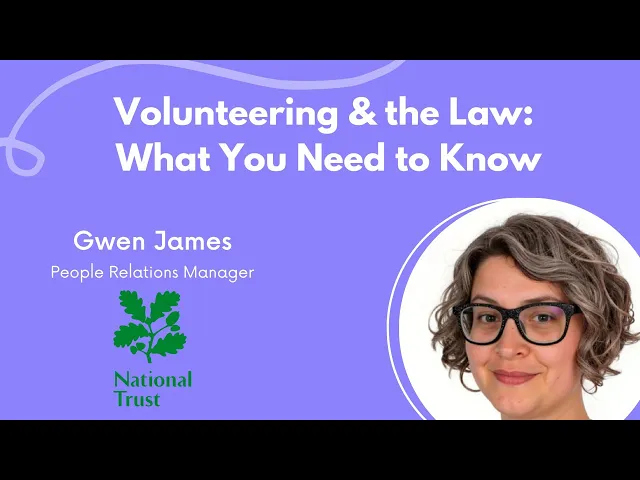
Volunteering and the law: what volunteer managers need to know

In short
Volunteers sit outside employment law as long as the relationship stays genuinely voluntary, Gwen James of the National Trust explained, so use agreements rather than contracts and reimburse only actual expenses. Health and safety law covers volunteers in organisations that employ staff, and replacing paid roles with volunteers can lead to minimum wage and unfair dismissal claims.
In this Lunch and Learn, Gwen James, People Relations Manager at the National Trust, explained the law volunteer managers need to know: where volunteers and employees are treated differently, where they’re treated the same, and the grey areas in between. It’s a general overview for UK organisations, not legal advice.
Key points
Employment law covers employees and workers, not volunteers. The aim is to avoid creating an employment relationship by accident.
Health and safety law covers volunteers in any organisation that employs staff.
The Equality Act’s employment rules don’t cover volunteers, but its rules on services do.
Some councils treat regular fundraising by school-age volunteers as employment, so check yours.
Replacing paid roles with volunteers can lead to minimum wage and unfair dismissal claims.
Watch the full session below, including the Q&A. Under the video, we’ve summarised the key takeaways.
Avoid creating an employment relationship by accident
Volunteers sit outside employment law as long as the relationship stays genuinely voluntary. Gwen’s basics:
Volunteer agreements, not contracts, and role descriptions, not job descriptions.
Flexibility over when and how often people give their time.
Expenses that cover only what people actually spend. Flat-rate payments can look like pay.
Separate processes, such as a problem-solving policy instead of a grievance procedure.
A ruling since the session
Gwen mentioned a volunteer coastguard rescue officer who argued he was a worker. Since the session, the Court of Appeal has confirmed that he was a worker each time he attended an activity he could claim payment for. The lesson: courts look at how an arrangement works in practice, not at what the documents call it.
Health and safety covers volunteers too
If your organisation employs anyone, health and safety law covers your volunteers as well. Include them in risk assessments, give training that’s relevant to the role and the right protective equipment, and check anyone who drives on your behalf. Organisations run entirely by volunteers aren’t normally covered, but still owe a duty of care (HSE guidance).
The Equality Act and volunteers
The Act’s employment protections don’t cover volunteers, so there’s no legal duty to make reasonable adjustments for them, though Gwen encouraged it. Its rules on services do apply: the people your volunteers support are protected, and so are volunteers who take part in a service as its users.
Job substitution
There’s no legal definition, but replacing paid staff with volunteers can lead to minimum wage claims from volunteers and unfair dismissal claims from staff. Gwen’s advice:
Never replace a paid role like for like.
Let volunteers add to a role rather than fill it, with a member of staff leading.
Encourage former staff who want to volunteer to choose a clearly different role.
Questions from the session
Do perks count as payment?
It hasn’t been tested in court. Offer perks to all volunteers whatever hours they give, keep them discretionary, and avoid linking a reward with a cash value to hours.
Should volunteers sign their agreement?
Signing to confirm they’ve received it is fine. Problems start when an agreement commits someone to set hours.
Should we collect National Insurance numbers?
Gwen couldn’t see a reason to. A National Insurance number doesn’t show someone’s right to work, and you should only collect the personal data you need.
Keeping volunteer processes separate
In Volunteero, you can add your volunteer agreement and handbook to an onboarding journey and record each volunteer’s acknowledgement with a form, while a full audit trail records every action. Book a demo to see how it works.
Related reading
About Gwen
Gwen James is the People Relations Manager for the National Trust, where she leads on best practice in volunteering and volunteer management. She’s also a trustee of a local city farm and has run volunteering projects for community-based organisations.
Written by
Co-founder and CEO
Ashley Staines is the co-founder and CEO of Volunteero. After seven years in investment banking, he started it to make volunteering easier to organise.


