

Investing in Volunteers: the process, how to prepare and the benefits

In short
Investing in Volunteers is the UK quality standard for good practice in volunteer management, assessing six quality areas, with an award that lasts three years. The process takes around a year, from a workshop and self-assessment to an assessment including interviews with volunteers, staff and a trustee. CHAS’s Fiona Harvey found it brings external validation and the volunteer voice.
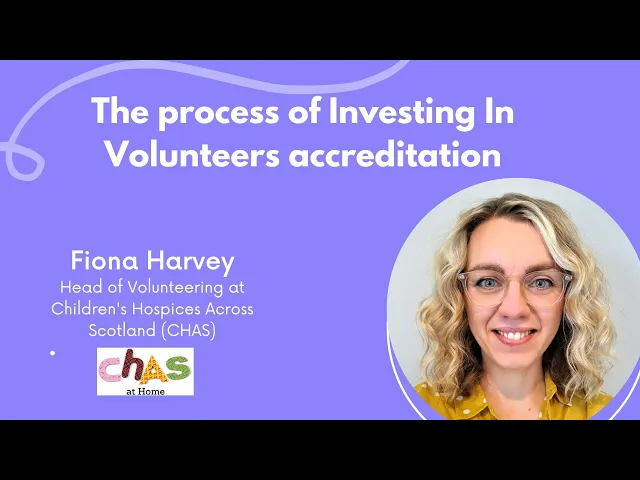
In this Lunch and Learn, Fiona Harvey, Head of Volunteering at CHAS (Children’s Hospices Across Scotland), explained what it takes to achieve Investing in Volunteers (IiV), the UK quality standard for good practice in volunteer management. CHAS has now achieved the standard seven times, and Fiona has led two of those assessments.
Key points
Investing in Volunteers assesses six quality areas, and the award lasts three years.
The process takes around a year from signing up to assessment, alongside your day job.
The assessor talks to a sample of your volunteers, staff and at least one trustee.
Briefing everyone beforehand takes the fear out of the assessment.
The report gives you the volunteer voice and a ready-made plan for improvement.
Watch the full session below, including how her team organised 65 volunteer interviews and the Q&A on cost and time. Under the video, we’ve summarised the key takeaways.
What is Investing in Volunteers?
IiV looks at six quality areas: vision for volunteering, planning for volunteers, volunteer inclusion, recruiting and welcoming volunteers, supporting volunteers, and valuing and developing volunteers. The award is valid for three years, then you renew (Volunteer Ireland). The awarding body is made up of Volunteer Now, Volunteer Scotland, NCVO and WCVA. Enquiries from Scotland go to Volunteer Scotland, and from England, Wales and Ireland, north and south, to the IiV team at Volunteer Now (Volunteer Now).
The six steps to the award
Typical timings, counted from confirming your contract (Volunteer Now):
Getting started: a two-hour workshop with your assessor, usually within a month.
Self-assessment: show how you meet each quality area, with three pieces of written evidence such as your volunteer policy, usually within three months.
Improving practice: agree an improvement plan with your assessor, usually within four months.
Assessment: usually within 12 months, with verbal feedback and a written report.
Achieving and celebrating: the result is met, met with conditions or not met.
Continual improvement and renewal.
How to prepare for the assessment
Fiona’s tips from CHAS:
Invite senior leaders and trustees to the workshop, so they see it’s a robust process.
Make the self-assessment a team effort, and ask your assessor for examples so it doesn’t grow too long.
Use your volunteer strategy as the basis for your improvement plan.
Send clean, anonymised volunteer data with role, team and length of service, leaving out inactive volunteers.
Spread the interviews out. CHAS held one interview day a week for six weeks, which left room for cancellations.
Brief staff and volunteers that the organisation is being assessed, not them, and tell everyone else what’s happening.
The benefits of Investing in Volunteers
External validation that carries more weight with your board than your own reassurance.
The volunteer voice: honest conversations you rarely have time for, plus small issues you’d otherwise miss.
Wider conversations about inclusion across staff and the people you support.
Recruitment: the badge helps attract volunteers and staff. It’s one reason Fiona applied to CHAS.
The same rigour CHAS applies to its regulated services.
Questions from the session
How much does Investing in Volunteers cost?
There’s no published price. The cost depends on how many volunteers and roles you have, so you request a quote, and a payment plan may be possible. Budget for staff time too.
Can one department or branch apply on its own?
It depends on your structure. Branches have applied separately in some organisations, so ask before you register.
What do assessors ask volunteers?
It’s a conversation rather than set questions. Newer volunteers are asked about their recruitment and induction, and the assessor follows up on themes that come up.
Getting your volunteer data ready
In Volunteero, reporting tools include custom real-time dashboards and data export to Excel, so you can quickly pull together the anonymised volunteer list your assessor needs. Book a demo to see how it works.
Related reading
About Fiona
Fiona Harvey is Head of Volunteering at CHAS (Children’s Hospices Across Scotland).
Written by
Co-founder and CEO
Ashley Staines is the co-founder and CEO of Volunteero. After seven years in investment banking, he started it to make volunteering easier to organise.


