

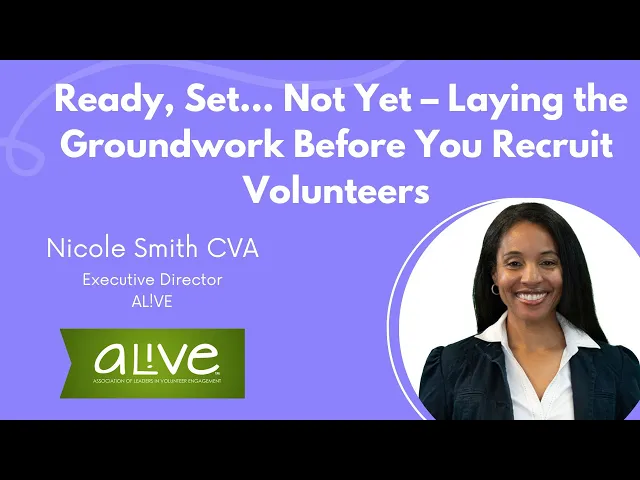
Before you recruit volunteers: how to get your programme ready first

In short
Get your programme ready before recruiting, or new volunteers will drift away, argued Nicole R. Smith CVA of AL!VE. Assess the gaps, check policies, brief staff who work with volunteers and test your own onboarding at least once a year. When you do recruit, ask current volunteers first and replace “we need volunteers” with a clear invitation.
In this Lunch and Learn, Nicole R. Smith CVA, Executive Director of AL!VE, the US Association of Leaders in Volunteer Engagement, argued that many of us approach volunteer recruitment backwards. Recruiting before your programme is ready, she said, is like pouring water into a leaky bucket.
Key points
Fix the gaps in your programme before you recruit, or new volunteers will leak away around their first shift.
Clear policies and a “who to call” list help volunteers and staff know where to go when something goes wrong.
Staff who work with volunteers need a short briefing first, because one bad interaction can lose a volunteer.
Go through your own onboarding at least once a year, and ask friends or family to test it too.
When you do recruit, ask current volunteers first and replace “we need volunteers” with a clear invitation.
Watch the full session below, including her story of cutting a 25-step sign-up process down to size. Under the video, we’ve summarised the key takeaways.
Assess your programme and find the gaps
Nicole suggested starting with a recognised framework, such as AL!VE’s standards and self-evaluation tool. You won’t fix every gap overnight, but knowing where the leaks are lets you prioritise the big ones and ask for help.
Volunteer policies and procedures to check
Orientation, scheduling and hours tracking, as they really work.
A “who to call” list for volunteers and for you, from marketing contacts to incidents at events.
A route for raising concerns, so volunteers feel heard before they go straight to the chief executive.
What happens when expectations aren’t met, such as repeated lateness. Letting it slide sends a message to everyone.
Recognition, media and social media.
Train staff who work with volunteers
One bad interaction with a busy member of staff can lose a volunteer. Nicole’s ideas:
Ask HR for 30 minutes in new starter induction to explain your volunteer programme and its impact.
Write a one-page guide to working with volunteers, starting with basics like saying hello, or record a short video.
Make reading it a condition of requesting a volunteer.
People can’t help retain volunteers if no one has told them they’re part of it.
Set up the environment before volunteers arrive
Think through the who, what, when, where, why and how. For office roles, have a working computer and logins ready, so nobody spends a whole shift waiting. For events, say where to meet and what to wear. For virtual roles, sort out access and email accounts in advance. Block time in your diary to plan this rather than building it as you go.
Test your volunteer onboarding process
Go through it yourself at least once a year.
Use mystery shoppers: ask friends and family to sign up and report on response times, tone and broken links.
Count the steps from finding the role to the first shift. Nicole suggested around five as a guide. A little friction is fine, but don’t wear people down.
Automate the repetitive parts so you have more time to talk to volunteers.
Remove out-of-date roles, so nobody signs up for something that no longer exists.
Add check-ins in the first three months, when drop-off tends to be highest.
How to make the invitation
Ask current volunteers first, personally, especially those you haven’t heard from lately. Give them tools to recruit for you, such as small cards to hand out. Lead with what makes you different from similar charities, and share impact as numbers and stories together. And watch your language:
Instead of “we need volunteers”, try “join us” plus what volunteers will help achieve.
Instead of “we can’t do this without you”, try “your help extends our reach”. The first can lead to burnout or overstepping.
Instead of “volunteer job”, say “volunteer opportunity”.
Smoother onboarding with Volunteero
In Volunteero, an application form can automatically start an onboarding journey with stages for agreements, training, bookings and checks, and references are collected automatically. Book a demo to see how it works.
Related reading
About Nicole
Nicole R. Smith CVA is Executive Director of AL!VE, the Association of Leaders in Volunteer Engagement. She’s a speaker, author and podcast host with 20 years’ experience across the arts, nonprofit and sports sectors.
Written by
Co-founder and CEO
Ashley Staines is the co-founder and CEO of Volunteero. After seven years in investment banking, he started it to make volunteering easier to organise.


