

How charities can build better corporate partnerships

In short
Charities build better corporate partnerships by showing how they fit a funder’s mission, why they want a partner and what the partnership would involve. Kate Butchart advised researching first, seeking a warm introduction and treating small grants and volunteering programmes as a way in. Be honest about challenges and offer something back, such as expertise or awareness raising.
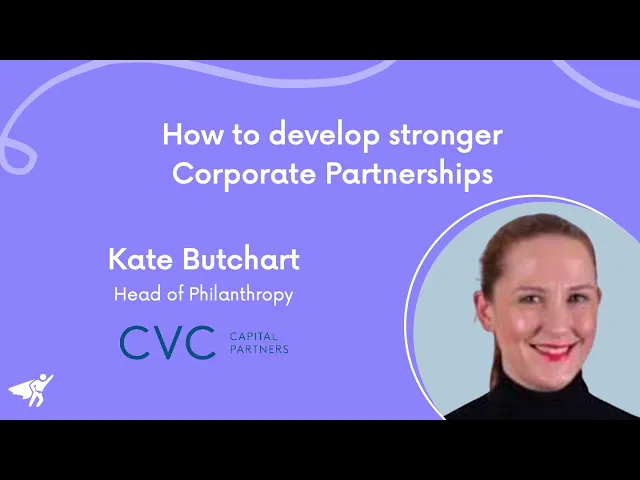
In this fireside chat at the Volunteero Summit 2023, Kate Butchart, then Head of Philanthropy at CVC Capital Partners, shared what she looks for in a charity partner after around 20 years in corporate social responsibility (CSR). She covered finding and approaching the right partner, the value a charity can offer, keeping the relationship strong and corporate volunteering.
Key points
Show how you fit the funder’s mission, why you want a corporate partner and what the partnership would look like.
Corporate funders are rarely silent partners, so talk openly about the relationship you both want.
Research first, then ask for a warm introduction rather than contacting everyone at a company.
Small grants, matching and volunteering programmes are often the way in to bigger, longer partnerships.
Be honest about your challenges, the volunteering you can realistically offer and the cost of what you give back.
Watch the full session below, including her views on the shift from CSR to ESG. Under the video, we’ve summarised the key takeaways.
What corporate funders look for in a charity partner
Kate works through three questions, in this order:
Do you meet the mission and criteria? Corporate teams are often small generalists, so teach them the problem, the data and how your model solves it.
Why us? Explain what a corporate partner adds. Wanting to diversify your income is a valid answer.
What will the partnership look like? It may include volunteering, awareness raising, office space or the company’s network, which Kate sees as underused.
Be ready for due diligence, and raise a difficult year or bad news up front. Your contact has their own approval committees, so give them honest answers to take back.
How to approach a company for a partnership
Companies rarely publish how to apply, so start with research: LinkedIn, company reports and who funds charities like yours. Corporate foundations registered in England and Wales appear on the Charity Commission’s register of charities.
Then use your networks: many referrals come from a company’s own staff and partners. Ask someone you know for an introduction, but don’t email everyone at the firm.
Don’t expect a large grant first. Kate treats small grant, matching and volunteering programmes as a pipeline for longer partnerships.
What value a charity can offer a corporate partner
Expertise. Kate learned most of what she knows from charity partners, not other companies.
Awareness raising. Share your campaigns through the company’s internal communications.
Help with your mission. In one partnership, employees who were parents helped a children’s charity take its schools programme into their children’s primary schools.
Talks or seminars. Be clear about what they cost you, and don’t be afraid to charge in a smaller partnership.
Giving back makes a partnership stickier and more likely to grow.
Getting corporate volunteering right
Volunteering should fit the company. Professional services firms often centre on pro bono work, while a small office may need two mentors, not twenty. Lead with the mission, then ask what works for them.
For skills-based volunteering, define the need. A general request for HR help is hard to act on; a specific one, such as a performance management system for a growing team, lets a CSR lead find the right expert. Check your own volunteers too: you may already have lawyers or finance professionals.
Questions from the session
Is charity of the year right for a small charity?
It’s a demanding fundraising partnership. Smaller charities may do better with local employers, many of which fund causes where their staff live.
Do companies support employees’ own volunteering?
Many offer volunteering leave, match volunteer time with donations or give small grants once someone has volunteered set hours. Ask your volunteers whether their employer does.
Managing corporate volunteers with Volunteero
With Volunteero’s scheduling tools, you can restrict shifts to a group, such as one company’s team, and check volunteers in by QR code. Custom real-time dashboards and export to Excel make it easier to show a partner what its volunteers have done. Book a demo to see how it works.
Related reading
About Kate
At the time of the talk, Kate Butchart was Head of Philanthropy at CVC Capital Partners. She has worked in CSR for around 20 years, including roles at Morgan Stanley and Credit Suisse.
Written by
Co-founder and CEO
Ashley Staines is the co-founder and CEO of Volunteero. After seven years in investment banking, he started it to make volunteering easier to organise.

