

Inclusive trustee recruitment: how to diversify your board and volunteers

In short
Inclusive trustee and volunteer recruitment starts with a welcoming culture, then removes barriers from roles and processes. Rob Avann advised cutting role criteria to the essentials, offering a mix of roles, accepting different ways to apply and reviewing expenses. To diversify a board, he suggested term limits, shadow trustees, reserved places for first-time trustees and clear time commitments.
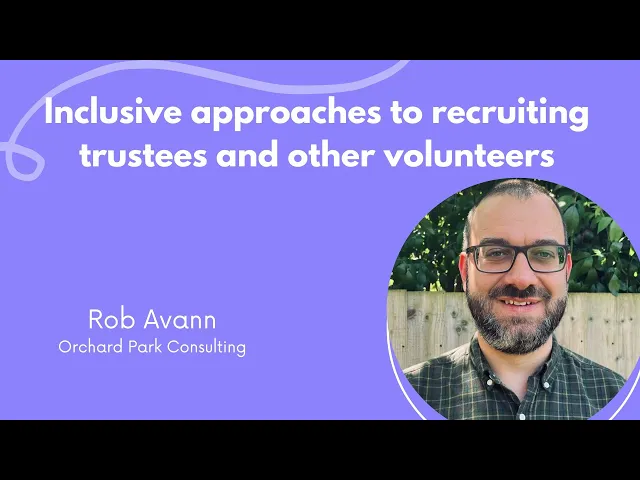
In this Lunch and Learn, Rob Avann of Orchard Park Consulting, a charity consultant and interim CEO who has been a trustee for 16 years, shared inclusive approaches to recruiting trustees and other volunteers. He covered why diversity matters, why culture comes before tactics, and how to take barriers out of your roles and recruitment process.
Key points
Diversity of thought and experience helps groups make better, more rounded decisions.
Get the culture right first, or even the best recruitment plan will struggle.
Every selection criterion is also a barrier, so keep only the essentials.
Open, fair recruitment should be the norm for trustees as well as volunteers.
Start small with one role, prove it works and build from there.
Watch the full session below, including his ideas for opening up board meetings to new voices. Under the video, we’ve summarised the key takeaways.
Why board diversity matters
Rob argued that the people a charity serves should see themselves represented on its board and leadership team, not just in frontline services. The Charity Commission’s research into trusteeship, published in April 2025, shows how far there is to go: 92% of trustees are white, compared with 83% of the population, and the median age is between 65 and 69. Over half were asked to join by the chair or another board member, and only 6% answered an advert.
Start with an inclusive culture
Rob sees two parts to a culture that welcomes difference, and they need to be in balance:
An open, psychologically safe environment, where people can talk openly about their experiences and newcomers are met with kindness and curiosity.
Clear boundaries that you enforce, through policies on bullying, harassment and social media, clear expectations of volunteers, and action whenever an incident happens, or people lose faith.
If the word “diversity” causes friction, Rob suggested framing the conversation around community instead.
How to make volunteer recruitment more inclusive
Audit your diversity and skills gaps against the people you serve, and plan actions to close them.
Cut role criteria to the essentials. A long list of requirements turns away people who would do the role well.
Offer a mix of roles at different times, places and levels of commitment, including outside working hours.
Review your expenses offer, including support such as childcare or a meal.
Accept different ways to apply, not only a CV and covering letter, and offer an informal chat first.
Advertise deliberately where the people you want to reach already are, and test your adverts with them.
Use diverse recruitment panels and give every applicant feedback.
Above all, recruit people for their perspective, never as a token gesture.
How to diversify a trustee board
Term limits and a flexible board size, to make room for new people.
An equality, diversity and inclusion working group that reports to the board with an action plan.
Shadow trustees and observers, who attend meetings and ask questions without being full trustees.
Reserved places for first-time or young trustees, valued for their experience, not asked to speak for a whole group.
Co-chairing, and changing when and how the board meets.
Clear time commitments in every trustee role description.
Can charities pay trustees?
Rob suggested considering paid trustee roles, with care. Since the session, the Charity Commission has updated its guidance, Charities paying a trustee or a connected person (CC11). It says being a trustee is generally a voluntary role, and paying for trustee duties should be exceptional and temporary, with a power in your governing document or Commission authority. It also covers when you can compensate a trustee for lost earnings, so people don’t have to step down for financial reasons.
Reaching more people with Volunteero
With Volunteero’s recruitment tools, you publish an opportunity once and it appears on your website search board, the Volunteero Marketplace and GoVo. Configurable application forms let you choose your own questions, with document uploads and digital signatures. Book a demo to see how it works.
Related reading
About Rob
Rob Avann is a values-led charity consultant, interim CEO and mentor, with over 8 years as a charity CEO and 16 years as a trustee. You can contact him through Orchard Park Consulting.
Written by
Co-founder and CEO
Ashley Staines is the co-founder and CEO of Volunteero. After seven years in investment banking, he started it to make volunteering easier to organise.


