

Trustees’ responsibilities for volunteers: governance, risk and safeguarding

In short
Charity trustees can delegate day-to-day volunteer management but not their responsibility for it, Kirsty McEwan of Higgs LLP explained. Boards should list volunteer risks on the risk register, treat safeguarding as a governance issue, report serious incidents to the Charity Commission promptly and ask for regular data on volunteering rather than reassurance.
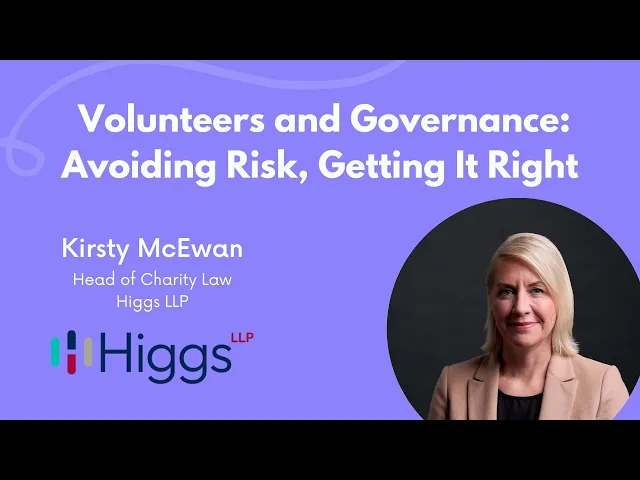
In this Lunch and Learn, Kirsty McEwan, who leads the charity and not-for-profit team at Higgs LLP, looked at volunteering from the board’s side of the table. It followed our session on volunteering and the law. It’s a general overview for charities in England and Wales, not legal advice.
Key points
Trustees can delegate day-to-day volunteer management, but not responsibility for it.
Volunteer risks deserve their own entries on the risk register.
Safeguarding is a governance issue, and policies should explicitly cover volunteers.
Serious incidents involving volunteers must be reported to the Charity Commission promptly.
Boards need regular data on volunteering, not just reassurance.
Watch the full session below, including her case examples. Under the video, we’ve summarised the key takeaways.
What trustees can and can’t delegate
Trustees are collectively responsible and can’t delegate their overall responsibility, as the Commission’s guidance The essential trustee (CC3) sets out. What stays with the board:
Whether and how volunteers are used, and which activities they do.
Approving key policies, such as recruitment, safeguarding and health and safety.
Setting the risk appetite and making sure there’s enough resource for training, insurance and monitoring.
Recruitment, induction, supervision and training can be delegated, within a framework the board approves, with clear triggers for escalating concerns.
Putting volunteers on the risk register
Kirsty suggested asking what the board’s top five volunteer risks are and how each is mitigated. The main ones she sees: safeguarding, gaps in insurance cover, inappropriate expenses or payments that look like pay, activities with no risk assessment, misconduct that harms your reputation, and legal issues such as employment status and data protection.
On insurance, the Commission’s guidance Charities and insurance (CC49) advises checking that each policy explicitly includes volunteers and covers what they actually do.
Safeguarding is a board responsibility
Kirsty’s questions for boards:
Does the safeguarding policy explicitly cover volunteers?
Are DBS checks done whenever a role is eligible?
How are concerns about volunteers reported and escalated?
Have trustees had safeguarding training themselves?
Since 1 September 2026, supervision no longer takes a role with children out of regulated activity, so some supervised volunteers are now eligible for an enhanced check with a children’s barred list check (DBS). See DBS changes for volunteer managers.
Serious incident reporting
A serious incident is an actual or alleged event that results in, or risks, significant harm to people, money, property or the charity’s reputation. For volunteers, that could mean an allegation of abuse, misused funds or a serious injury.
Who reports: the trustees are responsible, even when they delegate the task.
When: promptly, as soon as reasonably possible.
Police involvement doesn’t replace a report to the Commission.
So volunteer managers need clear criteria for what to bring to trustees.
What a board report on volunteers should cover
Kirsty suggested volunteer numbers and hours, incidents and near misses, safeguarding concerns and complaints, DBS checks and insurance, policies due for review, and volunteer feedback. Her red flags: volunteers never come up at board meetings, the risk register has no volunteer risks, or nobody knows for certain whether volunteers are insured.
Giving your board the evidence
Volunteero records every action in a full audit trail, and real-time dashboards and reports help you build the board report above. Book a demo to see how it works.
Related reading
About Kirsty
Kirsty McEwan leads the charity and not-for-profit team at Higgs LLP and has advised charities on constitutional, governance and regulatory matters for over 20 years. She sits on the Charity Commission’s panel as an approved Interim Manager and is a trustee herself.
Written by
Co-founder and CEO
Ashley Staines is the co-founder and CEO of Volunteero. After seven years in investment banking, he started it to make volunteering easier to organise.


