


In short
Most convictions in England and Wales become spent after a set period, though some never do. A basic DBS check shows only unspent records, while standard and enhanced checks can show spent ones too. Esther Champion advises inviting disclosure at interview and treating a check as information to weigh against the role, not a pass or fail.
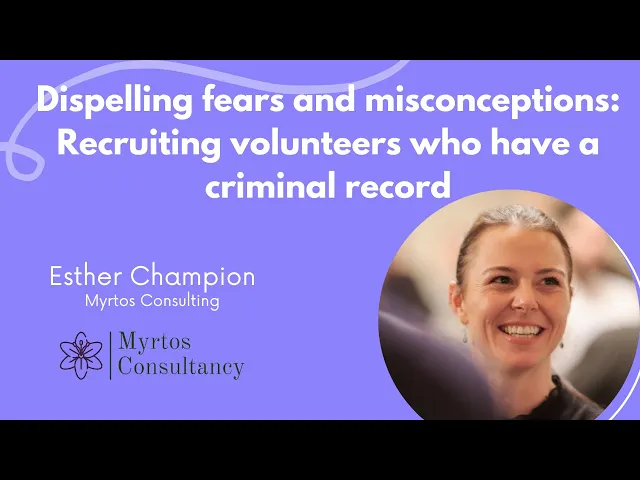
In this Lunch and Learn, Esther Champion, founder of Myrtos Consultancy, set out to give volunteer managers confidence about welcoming volunteers who have a criminal record. It’s a general overview for England and Wales, not legal advice.
Key points
Use person-first language: a person with a conviction, not an “offender”.
Most convictions become spent after a set period. Some never do.
A basic DBS check shows only unspent records. Standard and enhanced checks can show spent ones too, subject to filtering.
For roles that aren’t eligible for a standard or enhanced check, people don’t have to tell you about spent convictions.
A DBS check isn’t a pass or fail. It’s information to weigh against the role.
Watch the full session below, including her case study and Q&A. Under the video, we’ve summarised the key takeaways.
Why language matters
Labels like offender or convict build an identity around one action. Esther suggested “a person with a criminal record” or “a person with a conviction”, and seeing the person in front of you today. If someone discloses a conviction, share it only with the people who need to know.
Spent and unspent convictions
Under the Rehabilitation of Offenders Act 1974, most convictions become spent after a rehabilitation period. Since October 2023, the periods for adults are:
Prison sentence of 12 months or less: 12 months after the sentence ends.
More than 12 months and up to 4 years: 4 years after the sentence ends.
More than 4 years: 7 years after the sentence ends.
Community orders: when the order ends.
Cautions: simple cautions straight away, conditional cautions after 3 months.
Periods are shorter for people convicted under 18. Life sentences and sentences of more than four years for certain serious sexual, violent or terrorism offences never become spent.
What DBS checks show
Basic: unspent convictions and conditional cautions. It can be used for any role.
Standard: spent and unspent convictions and cautions, apart from those filtered out.
Enhanced: a standard check plus relevant information from local police.
Enhanced with barred lists: also shows whether someone is barred. Limited to regulated activity and a few other roles.
Use the DBS eligibility tool to choose the right level. Since the session, the definition of regulated activity with children has also changed: from 1 September 2026, supervision no longer takes a role out of it.
Asking about convictions fairly
Esther’s practical advice:
Invite disclosure at interview, not on the application form, so people don’t feel prejudged.
Explain your approach on your website: what you’ll ask, when and why.
Assess each disclosure against the role, and record why you decided as you did.
DBS also expects organisations using its checks to have a policy on recruiting people with criminal records (DBS guidance).
Why volunteering helps people move on
Volunteering offers what helps people stop offending: structure, purpose, positive company, new skills and a reference for paid work later. The recording includes Esther’s story of a man who rebuilt his confidence through a weekly volunteering role.
Questions from the session
Is having a criminal record a protected characteristic?
No. It isn’t one of the protected characteristics under the Equality Act 2010, but Esther encourages organisations to recruit fairly because of the difference it makes.
Are the rules the same across the UK?
No. The rules here apply in England and Wales. Scotland and Northern Ireland have their own disclosure rules and services.
Managing background checks in Volunteero
In Volunteero, a DBS check can be a stage in a volunteer’s onboarding journey, with staff sign-off when a check doesn’t come back clear. Background checks run through Verifile for DBS checks in England and Wales. Book a demo to see how it works.
Related reading
About Esther
Esther Champion is the founder of and lead trainer at Myrtos Consultancy, with over 14 years’ experience in criminal justice, from prison and probation work to mentoring people with convictions in the community. Her workshops help organisations confidently risk assess, recruit and support people with a conviction. To connect with Esther, email info@myrtosconsultancy.com.
Written by
Co-founder and CEO
Ashley Staines is the co-founder and CEO of Volunteero. After seven years in investment banking, he started it to make volunteering easier to organise.


